Sunday, 27 January 2013

Intuitions about Romance

by Judith Orloff M.D.

When we're looking for love (or under its intoxicating influence), we often miss seeing extraordinary signs and messages that pop up in our daily life to give us clues as to whether we're on the right track. However, if you can slow down enough to recognize and listen to your intuitive intelligence, it can reveal truth, warn you of danger, or help you understand people and relationship situations in new ways.

From Second Sight, here are five types of intuitive experiences you may encounter, and what they can teach you about your love relationships.

Body signals.


Your body has many ways of getting your attention. It could be goosebumps when a date feels just right or says something about you that rings "true." Or it might be your hair standing up on the back of your neck when a creep replies to your online dating profile.
How to use it in romantic relationships.
Most commonly referred to as a "gut reaction," your body's response to the world around you is often instant--quicker, in fact, than your conscious thought. Next time you sense your body is trying to alert you to something, check in with it. Are your shoulders tense? Is there a knot in your stomach? Or do you feel energized and excited? When you learn to read your body signals, a whole new type of information will be available to you. What's more, you may be able to avoid getting involved with destructive, unhealthy lovers, or be curious to pursue a really good guy who, at first blush, doesn't seem to be your "type."

Déjà vu.


This is when you feel as though you've had this exact conversation before with someone--even if it's someone you've just met--or you've been to this place before and know what's around the corner and up ahead, even though that's impossible.
How to use it in romantic relationships:
Instead of thinking it's strange and then moving on, don't let the experience go unremarked. Discuss it with a trusted friend, or write it down. Bringing a déjà vu experience that happens in the context of a relationship into the open energizes it, acknowledges its significance, and enables you to find out what it's trying to tell you or where it's trying to lead you. When it comes to romance, déjà vu can be a powerful affirmation that you're doing just what you're supposed to be doing in the moment. Or conversely, it may be a way of telling you to pause, think, and reflect on where you are right now, before proceeding ahead willy-nilly into a relationship you'll regret.

Synchronicity.


This is the experience of perfect timing, such as when you're thinking about a song right when you hear it on the radio, or the computer guy you found in the yellow pages turns out to be someone you had a mad crush on in college.
How to use it in romantic relationships:
Stay aware and look for synchronicity everywhere. Such moments let you know that you're in the flow--in the right place, at the right time. See if you can uncover its hidden significance. Were you meant to bump into this old love? Is the song "Don't Go Breaking My Heart" trying to tell you something about that "bad boy" you're crazy in lust with at the moment?

Seeing beyond.


This is when you're tuned in to an event that's happening right now, but in a different place. For example, you think of a long-lost boyfriend, and then he sends you an email in that instant. Or, you call your guy at work and ask him to pick up a pizza. Turns out there was a deadly accident on his regular route home.
How to use it in romantic relationships:
Your entire body--not just your brain--acts as an intuitive receiver, so the more conscious you become of your whole body, perhaps through a discipline like yoga, the more likely you are to tap into realities outside of your immediate setting. They will come to you in snapshot-life flashes--a taste, smell, sound, or a feeling in your body. Jot down your impressions. The better you get at tuning in, the clearer the messages will become. When two people are really "clicking," such experiences become even more commonplace, such as having intuitive flashes about your lover's health, or about where you two might be living in five years.

Intuitive empathy.


This is when you "pick up a vibe" from another person. For no apparent reason, you suddenly sense a person's deep loneliness, or you feel hostility coming from a person who is smiling at you.
How to use it in romantic relationships:
Being sensitive to other people's nature is a valuable skill--but it comes with perils. If you feel drained after meeting someone at a party, for example, pay attention so you can avoid giving him your phone number. Learning to "read" other people's feelings will improve your romantic relationships, as long as you don't "take on" others' moods and emotions. For example, when you can sense your boyfriend had a bad day, or is tense after talking on the phone to his mom, you can ask him questions to get him emoting. Such empathetic communication deepens and enhances love partnerships.

Wednesday, 23 January 2013

The Power from Within

According to the "Dean of Personal Development", Earl Nightingale, only 5% of the people who want to be successful in life actually achieve it.  In this talk, Earl tells us exactly how we can be one of those 5% rather than the 95% who never make it.

Saturday, 19 January 2013

Explaining the Unexplainable


Belinda Farrell is a Huna practitioner.
When Belinda was forty eight she collapsed with herniated discs and spinal nerve damage.  Threatened with paralysis by her medical doctors if she didn’t have surgery, Belinda instead chose to apply the ancient Hawaiian healing practices she had been learning for the past three years which are covered in this book.  Her back completely healed including childhood scoliosis.
Belinda retired from stunt car driving and, for fifteen years has been sharing these healing practices with others. She offers Reconnective Healing and Huna in Santa Cruz, Ca. and takes clients to Hawaii to teach Huna and swim with wild spinner dolphins.  The dolphins help us to dissolve fear with an open heart expanding our reality through their vibrational tones so that we experience our deepest joy.
In March she will be publishing a book called “Find Your Friggin’ Joy”.  In this book she will show her readers how to clean the “plaque” from their souls and reach the Higher Self.

Belinda has kindly allowed me to print an excerpt here from her book – Explaining the Unexplainable:


As a civilization we’re moving forward faster than ever before. If you don’t prepare yourself on the inside, you will likely be caught up in a whirlpool of fear and unresolved emotion. The news is filled with disasters in our outer world: earthquakes, floods, military uprisings, government breakdowns, corporations crumbling, real estate devaluation, oil spills, gas prices, water shortages and on and on. We are tenants living on Mother Earth temporarily. She will right the wrongs done to Her over time. How you handle what is happening in the world will reveal how SECURE you feel inside yourself. It is said that we are living in the DREAM we have made by our COLLECTIVE THOUGHTS. When we stop believing in the dream it will change its structure. When people stopped believing in Communism in East Berlin, the Berlin Wall fell. The majority of people now seem to be freeing themselves from conventional ideas that don’t work any longer. If it doesn’t feel good at the truth level, you need not participate. No one wants to be ruled by a dictator, and now the people are standing up and saying “no more.” As things change in our outside world, we begin to see how it is possible to change our inner world, especially if our ideas are somewhat outdated.

For example, take the way we’ve been conditioned to think about healing. The general consensus tells us to go to a doctor when we have an illness. But I’ll bet when we were young, the majority of you had your “boo-boo’s” kissed away by a well-meaning adult. We knew the boo-boo would heal by itself in just a few days. How many of us will know with conviction that we will be fine again when illness strikes.
As we grow older and develop more conscious skepticism, we lose touch with our connection to our UNCONSCIOUS MIND ... the part of us that RUNS OUR BODY. We already talked about how our unconscious mind serves as the computer to our conscious mind’s commands. So if you really want to communicate with the unconscious and change the negative patterns you’ve been accumulating, then begin to listen to what you’re saying to yourself. Are these things you would want anyone to hear? What’s your inner script? When you are aware enough to be able to write those phrases down, you’ll see what direction your unconscious mind is taking and why your body has been doing what it’s been doing.
Eric, 58, in a wheelchair, came to me for a healing session. At 19 he broke his neck in a car accident. He told me he knew he had set up this accident long before it happened. Unconsciously, he wanted to know what it felt like to be paralyzed. Whatever the unconscious believes to be true becomes your reality. Now Eric was ready to heal himself from feeling like a victim. He has been able to unplug from the burden of “victim thinking” thus freeing himself to be lighter. Now, he invited his Higher Self to begin the healing.
Martha had cancer when she came to see me years ago. At the time I was doing only hypnosis and past-life regression. At five years of age, Martha’s mother died suddenly. As a child unable to understand death, Martha decided that she was to blame for her mother’s death. Developing cancer was her way of punishing herself and ultimately joining her mother. In the regression, Martha’s mother revealed herself and the reason for her death, which had nothing to do with Martha. Finally getting the closure she needed, Martha’s body began to respond to the medication given to her to stop the cancer. Martha recovered from the cancer. Our unconscious desires are running our body. Getting in touch with the way they have been programmed will open our eyes to how we want to proceed. The unconscious also holds the key to reach the Higher Self, which ultimately knows how to heal our illness.
As a Huna Practitioner of ancient Hawaiian healing, I learned about the three Selves of Man and the role that the Higher Self (which is in all of us) plays to change our DNA and heal the physical body. Forthe ancient Hawaiians, the ultimate goal was to reach the Higher Self. Clearing the unconscious mind of the negative thought-forms from the past, you can then send your “desires” up the pipeline to the Higher Self for activation.
I experienced this myself 16 years ago, when my spine collapsed with nerve damage. My son Brian was living with me in Tiburon and carried me to bed when I could no longer walk. I was told by medical doctors that I wouldn’t walk again without surgery. Brian and another well-meaning friend urged me to go the “safer surgical route.” Not wanting to be cut, I decided to put the Huna recipe into action. Within four days of actively doing these processes, my back recovered completely ... even healing my scoliosis I had since birth. Shocked that I could walk again and feel normal, Brian was more fearful of his own “inner cleansing process” which he was not ready to comprehend. Personally, it felt like I had won the lottery, only better. I could heal myself together with my Higher Self. These Huna practices really worked! That brought me lots of friggin’ joy! I decided to devote my life to teaching others how they could do the same.
So how do you explain the unexplainable? How do you explain calculus to a 3-year-old? Reaching our Higher Self is what some of us aspire to in hopes of receiving Divine Truth, yet it can belong to the realm of the unfathomable, to our limited conscious mind. Healing my back was nothing short of a miracle to me. Yet, the recipe was available and I followed it, as I clearly believed in it.
And now, if you are ready, if you make the choice to believe, we have for you the cleansing and the ancient cleaning practices and techniques that can bring back to you – if you are willing – your friggin’ joy.

You can find out more about Belinda Farrell and her books and courses at her website:  www.HunaHealing.com


Wednesday, 16 January 2013

How to Become Successful – the First Step

As a researcher and promoter of personal development and success systems the commonest question by far that I hear is “How can I be successful?” How to be successful is the driving force for most people with whom I come into contact. Not surprising really, as this is my niche and my area of special expertise.

Usually I answer with another question. “What does ‘success’ really mean to you?” This is not a cop-out. I believe this question must be answered before I can even begin to outline what I believe this person must do in order to be successful. I do not believe anybody can really be successful unless they know exactly how they personally define success.

I have met people I would describe as very successful, but who have very little money. Many successful people are not well-known. Some have no close family and few if any friends.

So, if success is not defined by wealth, fame, family situation, or friendship, then what on earth does define success?

The answer, again, is that success can only ever be defined by the person who wishes to achieve it.

The first step to becoming successful is therefore to set aside some quiet, uninterruptible time, and begin to define for yourself exactly what you mean by success. You should make sure you have at least an hour for this, and preferably more so that the exercise can be open-ended and continue for as long as you find necessary. I can promise you that if you truly want to be successful this will be the most valuable hour or two you have ever spent.

This should initially be a brainstorming session. The concept here is that you should write down everything that comes into your mind when you hear the word “success”. Do not limit yourself to things you think it should be. You are trying to arrive at your own definition of personal success, not what you have read as someone else’s definition. Anything goes here. Do not be judgemental – if the thought occurs then write it down. Be prepared to fill quite a few pages here and to spend a good twenty or thirty minutes, not just a couple of minutes filling a single sheet of A4!

When you have spent a minimum of twenty minutes doing this (and keep going well beyond if ideas are still popping into your head) you can begin sifting through those ideas and crossing out ones that are not relevant. Also look for ones that are just repeats or variants of others; keep the most relevant and cross out the others.

You should now put your scribbled lists aside. In fact, turn the paper over so you cannot see anything you have written. On a clean sheet of paper write in large, bold capitals:

WHO AM I?

Don’t try to answer this. Just read it, then sit in absolute silence for at least another five minutes.  Ten, if you can manage it. This should be a form of meditation. If you are used to meditating on a phrase, then meditate on that question. If not, don’t worry – just sit there in silence.

When the five or ten minutes is up, turn over your list of words and phrases that came into your head when you thought about “success”. Start a fresh list and write down some words and phrases that now seem to resonate with you as being a start of your definition of success. These words and phrases may come from your brainstormed list, but you may find there are some completely different ones that now come into your head.

What you are trying to do here is to make sure your own personal definition of “success” is truly aligned with your own inner “you”. Only when your definition of success is properly aligned in this way can you really start to become truly successful.

At this point, start trying to formulate a sentence or two from this new list. This sentence will be the starting point of your own personal definition of success. It will probably be quite different from anything anyone else will ever write. That is quite natural, as this is extremely personal, and not some definition foisted upon you by the media. Treasure it! This definition, I can assure you, is one of the most precious things you have, as it will be the starting point of your true success.

Your definition of success will evolve over time, and in a few years from now may be quite different from what you have just written. But it will be a true definition, and one you can now be happy to go out and seek.

Good luck!

Wednesday, 9 January 2013

Investing in Yourself


If you are interested in personal development it is important you commit to investing in yourself.  No matter what it is you want to improve, no matter what you want to achieve, it will almost certainly require an investment or will be much better and be achieved much quicker with the right investment.

Start by listing the areas of improvement to which you wish to commit.  This can be in a very wide area, and I am not limiting myself at all to one particular niche.  Have a look at my previous article about the Top Ten New Year Resolutions.  All ten are perfectly acceptable self improvement goals, and you can probably add quite a few more to this list.

Take a look around and see what resources are out there which could help you make serious inroads on those improvements you desire.  Examine them carefully.  There are a lot of scams out there, but there are also a lot of diamonds if you look carefully enough.  Try to find at least one for each of the areas on your list.  Don’t worry at this stage about how much money they may cost.  All that should concern you right now is whether you believe they will help you achieve your goals better or faster, or both.

Once you have come up with the list of investments you want to make in yourself and are reasonably comfortable that, at least for now, this is a fairly complete list, the next step is to work out how you will pay for them.

One problem many people have, though, is that after they have paid all their monthly bills there is no money left to invest in themselves.

What may surprise you, though, is that no matter how much you earn you will almost certainly still find there is no money left after paying the bills.  How can this be?

Parkinson’s Second Law

The answer lies in Parkinson’s Second Law.  You have probably heard his First Law – “work expands to fill the available time”.  But perhaps you missed the Second Law – “expenditure rises to meet the available income”.  Parkinson’s Second Law is often applied to bureaucracies and they way they can needlessly spend our money.  But it is equally applicable to personal expenditure.

The corollary of Parkinson’s Second Law is that if you look carefully at your spending you will always find cuts you can make without impacting noticeably on your overall lifestyle.

Your first step should therefore be to examine your budget very carefully.  Pretend you are a business which is not making profit.  Step back and look at that business as if you were the finance director (or maybe the bank manager!).  I think you will be surprised by some of the cuts you could make and still continue to enjoy life just as much.

Pay Yourself First

Once you have done this, regard yourself as your own primary creditor.  You owe yourself a lot of money, so start paying it back.

Pay yourself first.  Before you pay anyone else.  Do not feel guilty about doing this.  Every day of your adult life up to now you have paid everyone except yourself.  Now it is your turn!

How much should you pay yourself?  Well, that depends, of course.  It depends on many factors.  Not least of which is how much you managed to save off your budget – make sure at least half of this goes to you.  Some coaches suggest it should be a minimum of 10% of your gross earnings.  But again I stress this depends on your own circumstances and budget.  Just don’t allow it to be whittled down to almost nothing!

Put it in savings and investments that you resolve not to touch except when investing in yourself.

Create a Second Income

Whether you work for someone else or have your own business you should consider ways of creating a second income.  You can then reserve most of this new income to invest in yourself (well, the profit on it - as there will always be expenses).

One way you can do this is to set up an online marketing business.  There are some major advantages of choosing this route rather than, for example, finding an additional part time job somewhere.

The first advantage is that you will be completely in control.  You can invest as much or as little time as you like.  As your business grows you may decide to give up your "day job" and spend all your working hours moving your internet business forward - but that is entirely up to you.  There will be no boss looking over your shoulder telling you to speed things up or do things differently.  Of course, you should also recognise this can be a disadvantage - you will need to have some good self-discipline to ensure you spend enough time doing the right things.

The second advantage is linked to the first.  You do not have to work on specific days or at specific times.  You can choose when to do this work.  If you wake up in the middle of the night and cannot get back to sleep you can sit at the computer and do something to move your online business forward.

The third advantage is that once you have set up your business properly it will begin to generate profits for you even if you do not put a lot of effort in to grow it.  You will need to continue doing some work in order to maintain it, so I do not believe it is correct to call it "passive income", but it should certainly generate you high profits for not a great deal of work as long as you have built it correctly.

Be aware, though, that as with any other business an online marketing business will require you to invest time and effort.  Do not be misled by claims you will often see that suggest this is a miracle "instant millionaire" formula.  It is not!  You can certainly become very wealthy if you choose to do so, but this will not happen over night.

You will also probably find there will be a few false starts before you get your own formula right.  Ideally you should take advice from an internet marketing coach who has been there and done that and who can stop you needing to re-invent the wheel yourself.  This will not be cheap, but it will save you making costly mistakes and ultimately ensure you reach your goal faster if you choose the right coach.

Invest in Yourself

Once you have started this habit of paying yourself first, and have perhaps additionally created your second income, start to invest with this money.  Not in company shares.  Not in bricks and mortar.  You are going to invest in something far more valuable than that.  You are going to invest in yourself!

Saturday, 5 January 2013

Top Ten New Year Resolutions


As a personal development researcher I am always interested to know what it is people most want to achieve.  At this time of year many people crystallize their hopes and dreams in New Year Resolutions.  I was therefore fascinated to see the list, published by the University of Scranton last month in the Journal of Clinical Psychology, of the top ten resolutions people made last year:

1    Lose Weight

2    Get Organized

3    Spend Less, Save More

4    Enjoy Life to the Fullest

5    Staying Fit and Healthy

6    Learn Something Exciting

7    Quit Smoking

8    Help Others in Their Dreams

9    Fall in Love

10   Spend More Time with Family


I imagine most of my readers can identify with at least one of these resolutions, if not more.  Even if you have not made any of them specific New Year Resolutions you would probably be happy setting several as  personal goals if you believed you could achieve them.

When you look carefully at this list it is quite obvious that several of these hopes and dreams belong together.  For example losing weight and quitting smoking are both very good goals for someone who wants to be fitter and healthier.

I think the list could be narrowed down to improvements in the following five areas, all of which are aspects of the field of personal development and success:

1  Finance

2  Health

3  Personal Relationships

4  Time Management

5  Dreams and Ambitions

Some of these areas are covered in the four free e-books I provide to all subscribers to my mailing list.  If you have not yet joined my list and received your free books please do so right now so you can move further forward in achieving your own goals.  You can do this simply by entering your name and e-mail address in the box just above on the right of this page.

I want to work with my readers to help them achieve improvements in all these five important areas.  Over the next few months I will cover different aspects of each of them, both in my blog here and also in the additional ideas I provide in e-mails to my subscribers.  Not all these ideas will be relevant to everyone, but you can be certain there will be some that are perfect for you and will help you achieve the personal goals you have set yourself.  Keep your eye on your mailbox for the idea that is perfect for you.


Tuesday, 1 January 2013

New Year Message

I would like to wish all my readers and followers a very happy, prosperous, and successful 2013.

If we are to be happy, prosperous and successful then first we must do our best to make others happy, prosperous and successful.  No matter what religion influences you, or even if you do not subscribe to any religious belief at all, I am sure you agree with this sentiment.

With this thought in mind I would like to reproduce for you, with the kind permission of The Divine Life Society, a New Year message issued many years ago by its founder, Sri Swami Sivananda.  May we all apply its key inner meaning to our own lives this year in the way we personally interpret it, whether we are Hindu, Muslim, Christian, Buddhist, of another persuasion, or of no persuasion at all.

New Year's Message from A Divine Life Mission


by

Sri Swami Sivananda


Children of God!

A New Year of new life has come. Let every day of this New Year of Divine Life be filled with the thoughts of God who is in all and everywhere. A life sacrificed on the altar of Divine Mission, a life dedicated to God is a life of success, peace and joy. On this New Year day surrender yourselves to the Lord who is all around us here, and lead a carefree life of harmony and bliss.

Every day of this New Year should be spent in egoless service, all-embracing love and devotion to God. Stay your minds in Him by offering fervent and sincere prayers daily. Now is the time for you to start a spiritual life, not tomorrow. Japa, Kirtan and meditation are great healers of ills of life. Repeat the Name of the Lord. This indeed, is the way to God’s Kingdom.

One who does not yield to the wrong suggestions of the mind, who is untouched by the commotions of the world, who is pure in mind and heart, who aspires only for the divine good and peace, that is everywhere, enjoys all blessedness here and now. One who forgets himself in the good of others has the Divine Support. If you lead such a selfless life meditating on the Essence of God in all, you will attain Knowledge and Illumination.

Again and again, I exhort you to illumine your deportment with the glow of Love. Love is the mother of all virtues. He that has a heart abounding in Love has known the Lord and scaled the heights of wisdom. Love and God are not different. The Way of Love is the Way of God. It is the way of unity, power and prosperity.

Having become heroes by intense spiritual Sadhana, work with exhilarating charm and ceaseless vigour for the Divine Life Mission in order to show the Light of God to all those who are in darkness and thus end their miseries once for all. To spread the divine knowledge is the only way to cure the diseases of today’s world. With faith in God, live a divine life and awaken people to the spiritual values so that they may enter into a haven of blessedness on this very earth.

May the blessings of sages and saints be upon you all! May God bless you all!

Saturday, 29 December 2012

What is Christmas?

This week most of us have celebrated Christmas.  But what exactly should Christmas mean to us?

Most of my readers probably know Christmas has its roots in pagan religion.  It is a celebration of the death and then the rebirth of the sun – hence the date just after the Winter Solstice, when the sun is the lowest in the sky and then gradually rises higher and higher.

Ancient druids decorated trees with fruit and cakes.  Their custom was much more sustainable than ours.  They left those “Christmas trees” living in the wild rather than cutting them down to brighten a room inside the house for just a week or two.

Kissing under the mistletoe may also have been an ancient druid custom.  This may be because the white berry of the mistletoe was considered to represent the semen of the sun, and therefore kissing under it could perhaps increase the chances of fertility.  If you are attending a late Christmas party where there may be sprigs of mistletoe maybe you should remember this before kissing!

The idea of feasting and exchanging gifts comes from the Roman festival of Saturnalia.  During that festival, which was usually full of revelry which would make most of us blush, those with wealth and power were expected to display some humility and serve those with none.

The original Father Christmas, or Santa Claus, was St Nicholas, who lived in Myra in what is now Turkey – not, I am afraid, at the North Pole.  This real Santa Claus was a wealthy man who gave away his wealth to help the poor around him, particularly young girls who might otherwise have drifted into prostitution.  Santa Claus was particularly fond of and protective of children.

Christians have adopted, and adapted, these early celebrations to create the festival we now know as Christmas.  Celebrating the birth of someone who wanted us to renew our lives and become better people.

Whether you are Christian, Pagan, of another religion, or of none, you should perhaps wish to take the inner meaning of all these early elements of the season.  Reverence for nature, love, humility, charity and generosity all feature in the festival.  A festival of renewal and rebirth.

As John Lennon said in his “Happy Christmas” song, “So this is Christmas, and what have you done?  Another year over and a new one begun.”  A time for renewal.  A new chance to change and create a better life for yourself and for all around you.

Achieve Your Biggest Goal

We are so very close to what is at least the Western New Year.  Many of us make resolutions which we will try to keep throughout the coming year.  A commendable effort, but very often one which we fail to maintain once the first few days of the year are past.

Whether or not you are planning to make New Year Resolutions, I urge you to use this opportunity to achieve a goal you may have had in mind for some time but have so far not managed to reach.

What is the goal you most wish to achieve over the coming year?  Do you immediately know what it is, or do you have to think about it?

If you know what that goal is, then great!  You have already made one of the most important steps towards realising it.  Before we can achieve a goal we must have a clear idea about what that goal is.

If not, then don’t worry.  Begin by brainstorming.  List on a sheet of paper all the goals you really want to achieve.  Write them as though you have already achieved them.

These should not be absolutely impossible goals.  “I can make myself invisible”, “I am the ruler of the world”, “I have X-Ray vision”, all spring to mind.  These are not the kind of goals you should be listing.  Nor should you put "I am a millionaire" unless you already have substantial wealth and can believe this would not be completely impossible in twelve months.  The latter can be a good goal to have, no matter how little money you have now, but it doesn't belong on this list of short term goals.  If you want a money goal, "I have increased my net worth by 10% over the last 12 months" might work here.

Make sure they are personal goals.  “I have helped bring about peace” is personal, but “there is world peace” is not (and is also rather impracticable to regard as being possible over the next year!).  “There is great love in my household” is not personal, but “I have a deep and loving relationship with my wife” is.

Other than those rules (possible, and personal) do not try to judge or think about a goal before you write it down.  And once you have written it down, don’t stop and think about it, not even to consider whether or not it does fit the rules.  Move right on to the next one.

Keep going with listing those goals until you have written down at least 10, all phrased as though you have already achieved them.  If they are all the same kind of goal, keep going until you have some diversity there.  For example, try to include some goals about your relationships, or your career.

Now you can go through and check that all your listed goals fit the two rules.  Any that are not personal or that you feel are quite impossible, cross out.  In the case of the impossible ones, you should then think whether there is some intermediate goal on the way to this which is not impossible and which you have not already listed.  If so, write that down too.

The next step is to choose the one goal on which you most set your heart.  Not the one you think is most achievable – that is a cop out!  The one you really want to achieve more than any of the others.  Which goal would have the biggest impact on your life if you could achieve it right now?  Circle this goal.  This goal is what we will call your “Biggest Goal”.

Now take another sheet of paper and write the goal at the top of the page.  Next to it, write a deadline of one year from today.  Now brainstorm again.  This time, think of all the things you would need to do to achieve your Biggest Goal.  Write as many down as you can as fast as you can.  Don’t stop at 10.  Not even at 15 or 25.  Keep on going until you have written down at least 50 steps you could take.  This will probably be hard once you get past the first dozen or so steps, but keep going anyway.  Don’t worry about the order; don’t try to think what step comes next.  Just write down any steps you can think of that will help get you closer to your goal.

The final stage is this:  Look at the list of actions you can take and start doing them.  Some may be achievable in one day.  Most will not.  But that doesn’t matter, just begin working on them any way.  Every day, do something, no matter how small, which moves you one step forwards towards your goal.

When you have achieved one completely, tick it off.  Not all the actions can be treated this way, as many will probably be ongoing tasks – keep working on them.  But the key is you must do something every day, no matter how small it may seem, to bring you closer to your goal.

And you know something?  Three hundred small steps, taken together, are one gigantic step.  So well before the year is out you will have made major progress towards achieving your goal, and may even have achieved it completely!

If you follow the principles I have outlined here, a year from now you will look back and will be absolutely amazed at the difference it has made in your life!  Start now, and make sure you can achieve your Biggest Goal over the next twelve months!

PS Don't throw away the original list!  You are going to need it soon, as once you have achieved your Biggest Goal you need to start going for your Next Biggest Goal!

PPS Are you ready to make 2013 your most successful year yet?  Join Brian Tracy for his FREE webinar “12-Step Method For Setting and Achieving Your Goals” and reach every goal you set for the coming year! Get more information here: "Setting and Achieving Your Goals".

Thursday, 20 December 2012

Mayan Calendar

Tomorrow is the last day of the Mayan Calendar.  Not the last day of the year in their calendar - the last day of the calendar itself!

Should we be running to the hills for survival?  Not according to John Major Jenkins, an expert on Mayan Cosmology and Mayan sacred science.

John Major Jenkins is the author of two key books on this subject: "Maya Cosmogenesis 2012: The True Meaning of the Maya Calendar End Date" and "Galactic Alignment: The Transformation of Consciousness According to Mayan, Egyptian and Vedic Traditions".  You can purchase either of the above books from Amazon by clicking on the name.  If you wish to pay in pounds sterling or have the books shipped from the UK you may order the first here (Maya Cosmogenesis 2012), or the second here (Galactic Alignment).  Please do not hold Amazon or John responsible if the world ends before your books arrive! ;)

John's full article is appended below.  It is a long article, but very well worth reading.  If you don't have time to read it, though, the conclusion is this:  the end of 2012 is not the end of the world, but it is a time when we are being given the opportunity to sacrifice our self-centered, egotistical view of the world and our place in it, and to replace this view with that of a selfless, higher consciousness.  This applies equally to society as a whole and to each of us as individuals.

Here is the full text of the very carefully researched article by John Major Jenkins on the end of the Mayan Calendar.  It was written in 2010 and refers to what will happen as we enter 2012 as well as what may happen tomorrow, the 21st December 2012 or the last day of the Mayan Calendar.  Do you think he got it right?  My own view is that it really doesn't matter whether or not he did.  What is important is whether we will take this opportunity now to change ourselves, which is the only way we can change society.


The Mayan Calendar and 2012: Why Should We Care?


by

John Major Jenkins


In my own process of studying the Maya and their traditions, I moved progressively into deeper water with time. Twenty-two years in, I can report back to newcomers that the implications of the Mayan calendar are staggering, its connection to other cosmologies around the globe is deep, and its most famous artifact, the cycle ending date of 2012, encodes an understanding of the cosmos that modern science is unprepared to grasp.

That’s where the investigation leads, but we will not venture so far in this article. Many people will be introduced to the existence of the Maya and their calendar through the attention generated by the 2012 date. You may be one of them. In fact, I hope you are, because this article is written for you. How can we even begin to understand the Mayan calendar and its 2012 date? What is it? What was it intended to represent? What did the ancient Maya believe would happen as 2012 draws close? Sit back and read on, for there are answers to these questions.

In my speaking events and workshops, people ask questions and I’ve noticed that many of them are based on misconceptions. I will anticipate and address these, hopefully guiding you away from dead ends.It is no surprise that 2012, the so-called ‘end of the Mayan calendar’, is a topic filled with images of the end of the world, doomsday, and cataclysm. Many writers have and will exploit such a hot topic to play into human fears. They are not necessarily interested in understanding 2012 as the ancient Maya understood it. Here we must state a guiding principle so we can have a healthy approach to 2012: let’s honour the authentic Mayan tradition.

This seems self evident, but is rarely taken to heart by modern writers. As a result of this unfortunate situation, newcomers are likely to encounter a smorgasbord of ideas, information, opinions, and models about 2012. The loudest barkers in Carnival 2012, as my friend Jonathan Zap reminds me, are likely to be the first ones heard. There’s the Pleiadian faction, there’s the crop circle theorists, there’s the alien invasion crowd, there’s the doomsday tribe, there’s the ascension light workers. People like many choices on the menu, right? Sure, but what about the real ding an sich, the thing-in-itself? Are we interested in getting to the heart of the Mayan insight? I propose that we should be, and that such an approach yields interesting, satisfying, revolutionary, and lasting results.

A little research reveals that a large cycle in the Mayan Long Count calendar ends precisely on December 21, 2012. The precision comes from a painstakingly established correlation between the Long Count calendar and our own Gregorian calendar. Scholars figured it out, beginning in the 1890s, testing and retesting the correct correlation. It was settled by 1950.

The Gregorian calendar and the Long Count calendar are simply two different methods of tracking time. Each one tracks one day after another, but designates the days with different symbols and words. The correct correlation between the two means that, for example, 9.16.4.1.1 in the Long Count equals May 7, 755 in the Gregorian calendar. We are simply correlating two different systems. It’s the same challenge of correlating the ancient Egyptian calendar, or the ancient Hindu or Roman system, to a time frame we recognise. With the ‘key’ of the correlation, we can make a precise conversion between the Mayan calendar into our own. It’s not rocket science, and there’s no need to mystify it.

What you need to know is that scholars have isolated the precise correlation for the Mayan calendar, such that the end of the 13-baktun cycle in the Long Count (written 13.0.0.0.0) falls precisely on December 21, 2012. Most importantly, the surviving 260-day calendar (the tzolkin) among the Maya today verifies this correlation, since it confirms that the cycle-ending date falls on 4 Ahau in the tzolkin. Authors that write popular books and broadcast other notions have simply not done their homework.

Next, what is the Long Count and how does it work? The Long Count calendar system was developed about 2,100 years ago in southern Mexico. Archaeologists know this because the first carved monuments with Long Count dates appear in the first-century BCE, mostly in the state of Chiapas in southern Mexico. Theoretical reconstructions of the calendar that trace its origins further back in time are possible, but for now we can rest safely with the carved monuments that date to the first-century BCE. This is a good indicator of when the Long Count was formally inaugurated and carved in stone.

A typical Long Count date contains five place values. A baktun is a period of 144,000 days. A katun is a period of 7,200 days. A tun contains 360 days. A uinal contains 20 days, and a kin is a day. I’m surprised when newcomers begin to wonder how anyone can possibly know this. Some assert that the Maya disappeared long ago, so how do we know this information about their calendar? Well, the truth is that the Maya have not disappeared, as the popular misconception goes. The reason why we can say things with certainty about how the Long Count works is because scholars have reconstructed its operation from a careful examination of the archaeological evidence. It’s not so mysterious or far fetched for scholars to piece together fragments of a forgotten tradition, especially something as tangible as the basic mathematics of a calendar system.

A typical Long Count date is written 8.16.3.12.5. The cycle ending date is written 13.0.0.0.0. After this date, the calendar cycles back to 0.0.0.0.1. Why? Because there are 13 Baktuns in one Creation Cycle, or Age. We know this because there are several carvings that are called ‘Creation Monuments’, and they tell us that 13.0.0.0.0 is the completion of a World Age. The Long Count is thus part of a philosophy of time known as a World Age doctrine. It is a belief that many ancient cultures share, that the world passes through a series of chapters or Ages. For the Maya, an Age lasts 13 Baktuns, which is 5,125 years.

The Maya’s Creation Myth contains information about the World Ages, and therefore we can consult it to gain an understanding of what the ancient Maya believed occurs during a cycle ending. General principles can be identified. For example, at the end of all Ages, humanity goes through a transformation and is reborn. A person chooses from two ways, because free will is honoured. One can go the way of Seven Macaw, the vain ego-driven ruler who appears at the end of the cycle, or one can go the way of One Hunahpu, who sacrifices his false self and is reborn whole.

The point is that the Creation Myth actually provides relevant and meaningful information concerning the ancient Maya belief about what would happen as 2012 approached. Therefore, studying the messages in the Creation Myth is an effective approach for understanding 2012.

Another important question is, why did the Maya believe that the year we call 2012 in our calendar would be so transformative? What is so special about 2012? The answer to this has been the focus of my pioneering research. My 1994 article “The How and Why of the Mayan End Date” really broke the case, as it identified how a rare astronomical alignment (the ‘galactic alignment’) was encoded by the Maya into their Creation Myth. My 1995 book The Center of Mayan Time explored my new findings further, by examining the early Maya site, Izapa, that invented the Long Count cosmology. More discoveries occurred in 1995-1997, and were reported in various articles and in my books Izapa Cosmos (1996) and Maya Cosmogenesis 2012 (1998). The galactic alignment is the key to understanding why the ancient Maya believed 2012 (or, to be more accurate, ‘the years around 2012’) would be so transformational.

What is the Galactic Alignment?
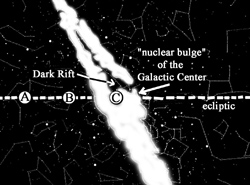


  A = the solstice sun’s position 4,000 years ago. B = the solstice sun’s position 2,000 years ago. C = the solstice sun’s position in era-2012 (the galactic alignment). Note the dark rift and the crossroads of the Milky Way and the ecliptic.

The galactic alignment is a rare alignment within the cycle of the precession of the equinoxes, or let’s say ‘precession’ for short. Precession is thought to be caused by the slow wobble of the earth on its axis. The earth spins once every 24 hours, giving us the day cycle. But like a spinning top it also wobbles very slowly, making one complete wobble in just under 26,000 years. This phenomenon changes our angular orientation to the larger field of stars and constellations that surround us. One effect of the precession is that the position of the sun on a solstice or equinox slowly shifts in relation to the background stars. Ancient skywatchers might observe the stars of Capricorn rising ahead of the dawning solstice sun. Eight hundred years later, however, it will be the stars of Sagittarius. The constellations served as markers for this celestial shifting.

For the Maya, the bright band of the Milky Way was a very important feature of the night sky. It was seen to be a river, a road, a cosmic snake, a Great Mother, or even a celestial ballcourt. Compared to the very wide constellations, the Milky Way is a better marker for precessional shifting, because it is thin, like a ‘finish line’ in the sky. If the sun’s position on, say, the December solstice, was tracked, skywatchers would notice it shifting closer and closer to the bright band of the Milky Way. According to my pioneering research, ancient Maya skywatchers noticed this shifting, and calculated forward to the future day when the December solstice sun would line up with the Milky Way. They even used a more precise marker for the alignment, the dark rift in the Milky Way, which lies right along the Milky Way’s mid-plane.

Modern astronomers call the Milky Way’s precise mid-plane the ‘galactic equator’. So, a good definition of the galactic alignment is ‘the alignment of the December solstice sun with the galactic equator’. Modern astronomers have largely ignored this alignment phenomenon, but one named Jean Meeus calculated it after being encouraged to look at it by astrologer Daniel Giamario. With his calculation, and recognising that the sun itself is one-half of a degree wide, we arrive at a reasonable ‘alignment zone’ that stretches from 1980 to 2016. This is the ‘alignment zone’ of the galactic alignment. In the mid-1990s I pioneered a comparative analysis of Mayan traditions, such as the ballgame, king-making rituals, and the Creation Mythology, to show how the Maya were aware of this future galactic alignment (also sometimes called ‘the solstice-galaxy alignment’).

The galactic alignment occurs at an important location along the Milky Way – right at the crossing point formed by the Milky Way and the ecliptic (the path followed by the sun, moon, and planets). This crossroads in the sky is a critical feature of Mayan star lore. It is the Mayan Sacred Tree. Most interestingly, this cross targets the ‘nuclear bulge’ of the Galactic Centre. For this reason, the galactic alignment is often described as an alignment to the galactic centre, which it is, generally speaking.

These astronomical features had profound symbolic meaning for the ancient Maya. And some still do for the modern Maya. The Milky Way was the Great Mother, the galactic centre was her womb, and the dark rift was her birth canal. The December solstice sun was also very important, energetically, because that day signals the turnabout in the year, when increasing night shifts to increasing light. After the December solstice, the light begins to return as days grow longer. When THAT sun, the December solstice sun, shifts into alignment with the dark rift ‘birth canal’ of the Milky Way, the Maya believed the world would be reborn. It constituted a good location to place the end of a World Age, 13.0.0.0.0 in their calendar, and the beginning of the next Age. The cycle ending is ultimately about renewal.

The galactic alignment, so defined, happens only once every 26,000 years. This is the big news, why we should be astounded at what the ancient Maya achieved. If we honour it only as a profound galactic cosmovision, whether or not we believe in its transformational power or correctness, that would be enough to shatter the continuing stereotypes of the ancient Maya as barbaric savages. Progress in understanding the brilliance of the ancient Maya’s achievement is hindered by stereotypes and clichés propagated by an exploitative media, as recent Hollywood movies illustrate. They play into fear and deep-set biases, and newcomers should be on alert for attitudes and books that disrespect the authentic Mayan calendar tradition, the one that makes December 21, 2012 equal to 4 Ahau, 13.0.0.0.0.

But what of it? Does the galactic alignment somehow ‘cause’ change? This is an inevitable question, and one that is currently not easy to answer within the limits of our science. Astrophysicists look at distant galaxies, peer into galactic centres, and theorise about black holes, quasars, and dark matter. That’s all well and good, but they have not looked at the empirical effects of the galactic alignment phenomena. The possibility that our changing angular orientation to the galactic plane might somehow trigger seasonal changes on Earth, over very long periods of time, should be examined. Speaking from personal experience, however, it’s been very difficult to get astronomers and scientists to engage in a rational dialogue about the galactic alignment, although there have been some exceptions.

I’ve suggested scientific research that may answer the question of how the galactic alignment effects life on planet earth. It is, after all, an interesting question. In my 2002 book Galactic Alignment I discussed the Cosmecology theory of Dr. Oliver Reiser. Combining Reiser’s ideas with the galactic alignment concept, which he was not aware of, results in a possible model by which galactic alignments trigger consciousness. In 1995 I noted that our sun is roughly 26,000 light years from the galactic centre. I wondered if this could mean that precession is somehow entrained to this distance. A principle of sub-atomic physics that I located, later confirmed in the work of Reiser, provides the missing clue. The principle of ‘proton precession’ observes that protons have a varying wobble rate or ‘precession’ just like the earth does. The frequency of the wobble is directly related to the strength of the magnetic field that the proton is in, as well as its distance from the source of field. Here we have a principle that connects distance from source to the precession rate.

I am neither a sub-atomic particle physicist nor am I an interstellar astrophysicist, so this is not really my department. I offer this observation to others who are more interested in exploring the empirical models by which precession, and galactic alignments, may effect consciousness on earth.

We may be on the verge of a revolution in how we, in Western countries, understand the cosmos and our relationship to it. We may be going through a paradigm shift, much like the seventeenth century, when the sun became the centre of the cosmos during the Copernican revolution. Now, inspired by Mayan cosmology (just as Copernicus was inspired by Greek precursors), we might begin to see the womb of the Great Mother as the centre of the universe. This shift has important ramifications for our socio-political assumptions, for ‘god the solar father’ cannot be reborn unless it is through ‘goddess the galactic mother’. A higher principle that has been winnowed out of Western thought is reasserting itself, and our embracing it may be the key to transforming our unstable world into a sustainable one.
 

What Does 2012 Mean for the Modern World?


The pressing question is ‘what does 2012 mean for us?’ Consider this: the Maya offer us the 2012 date and tie it to a rare galactic alignment that our science barely acknowledges. They believed, for reasons we cannot quite grasp, that such an alignment would signal great transformation on the planet. If we look around us today, and recall events of the last twenty, fifty, and a hundred years, great transformation is indeed what is going on. Perhaps we should pay more attention to what the ancient Maya teachings actually say, rather than injecting modern assumptions and distortions into the 2012 discussion. There is no better place for accessing this Mayan wisdom than the Creation Mythology, otherwise known as the Popol Vuh or Hero Twin myth.

And here it is in a nutshell: 2012 bodes a challenge and an opportunity for humanity to rebirth itself. Such a transformational rebirth can only be accomplished through sacrifice, sacrificing the illusions that bind us to states of suffering and limitation. We can reconnect with the higher source, our true selves, the centre and source of the world. This invitation is reflected in the galactic alignment, our sun’s rare alignment with the cosmic heart and source (symbolised by the galactic centre).

This requires a little context and explanation. In the Creation Myth, the vain and false ruler Seven Macaw appears at the end of the cycle. He deceives and controls people, trying to take all the wealth for himself. He represents the archetype of self-serving egoism. That is the Mayan prophecy for 2012. Today, world leaders, megalomaniacal presidents, and even corporations all exhibit this trait. The Mayan prophecy for 2012 has come to pass. This is no accident. Ego takes control of the world at the end of the cycle, and this is a fact of the dynamics of cycles. We see this insight in many World Age doctrines, from the Hindus to the Greeks and especially among the indigenous peoples of the New World, such as the Maya. Spiritual light at the beginning gives way to darkness. Day turns to night, and at midnight the darkness has maximised. Year 2012 represents galactic midnight in the great cycle of precession. Everything is inverted; the ego denies any spiritual authority higher than itself. But because the ego’s vision is short-sighted, limited only to its own gain, it corrupts the world.

There is a second part to the Mayan prophecy in the Popol Vuh. Seven Macaw’s nemesis is One Hunahpu, the December solstice solar deity. He is the father of the Hero Twins, and much of the story is about facilitating his rebirth at the end of the Age. First, Seven Macaw, the ego, must be put in his place. In order for the higher consciousness to appear, for the mind and heart of humanity to be reborn, the self-serving squawking of ego must be stopped. The whole story is about the dynamic between the limited ego (Seven Macaw) and the eternal soul (One Hunahpu). Since One Hunahpu represents the December solstice sun, the entire myth is framed upon the galactic alignment. And here’s the key to the transformation, the key to putting Seven Macaw back into right relationship with One Hunahpu: sacrifice.

The challenge and the opportunity of 2012 lies within the province of our free will choice to sacrifice our illusions, the illusions that entangle our consciousness with the ego limitation of Seven Macaw. 2012 is not about something that ‘will happen’ in a predetermined sense while we sit around waiting. It is about our free will choice to open up and reconnect with the eternal wisdom, or hunker down in defeatism, closing our minds in fear.

These ideas, found in the Maya Creation Myth, are really perennial teachings. It is very significant that hidden within the depths of the Mayan calendar we find the same spiritual wisdom that resides at the root of all great spiritual traditions. Called the primordial tradition or the perennial philosophy, Mayan genius has linked up this global human heritage to galactic seasons of change timed by the galactic alignment of era-2012.

The ramifications of the 2012 opportunity are critical for creating a sustainable future. The key is embodying the higher wisdom, the higher vantage point, to resolve problems that are impossible to solve when consciousness retains an allegiance to lower consciousness, to the self-serving agenda of egoism.